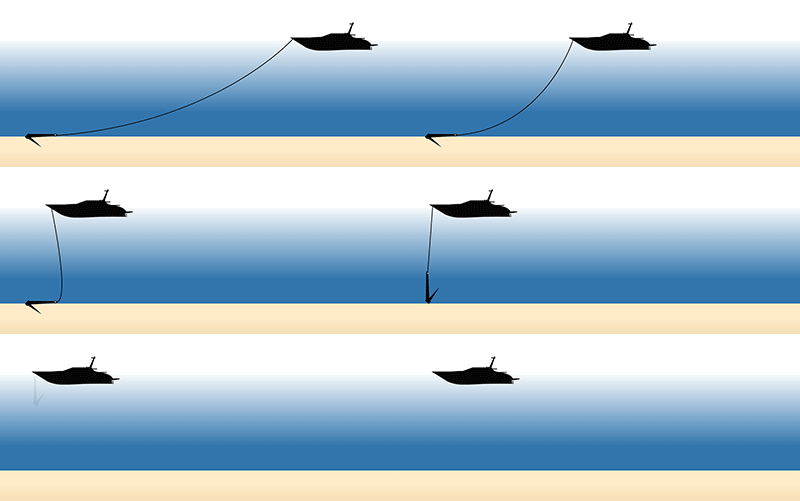
Safe Anchoring Guide
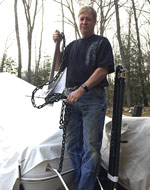
Safe Anchoring Guide
In order to insure your safety while on the water, it is important for you to master the fundamentals of proper anchoring. Our guide can help you learn how to safely anchor your boat, which will result in more enjoyable and stress-free time while aboard with your family and friends.
Getting to Know Your Anchor System
The important components in your anchor system include not only the anchor, but also the chain, rope, shackle and deck cleats. Each of these items must be able to deliver the performance and strength that you will need.
1) Anchor Rode – Your Anchor Line
Use a short length of chain and three-strand nylon line. The nylon is very elastic and greatly reduces shock loads on your boat and the anchor system. The chain protects the line against chafe from the seabed and it also helps to provide a horizontal pull on the anchor when it is initially beginning to set.
If you regularly anchor in 25 ft (8 m) of water or less, use 6 ft (2 m) of chain. For greater depths, use an additional 6 ft (2 m) for every 25 ft (8 m) of water depth, e.g.: use 24 ft (8 m) of chain if you regularly anchor in 100 ft (30 m) of water.
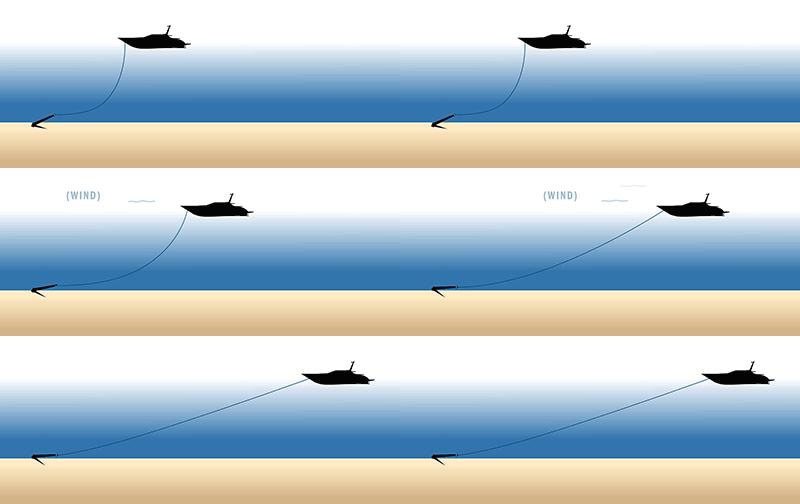
Anchor rodes that use all chain will lack the shock absorbing ability of nylon rope when the wind increases.
2) How to Determine Your Holding Power Needs
Be certain that your anchor can deliver the performance you will need for your boat type and the wind conditions. A “Lunch Hook” should be able to hold your boat in a 15-knot breeze. A main, or “Working Anchor” should hold up to 30-knots of wind. A “Storm Anchor” is for winds up to 42-knots.
A good rule of thumb to remember – as the wind speed doubles, the holding requirement quadruples! Use the table below to determine your holding power requirements for different wind speeds.
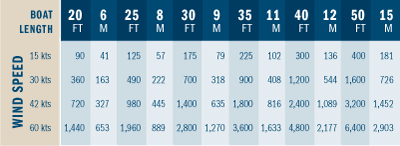
Note: This table assumes boats of average beam and windage. If your boat has above-average beam or windage, refer to loads for the next larger size boat. The numbers in columns for feet = lbs. and the numbers in the columns for meters = kg.
3) Using Adequate Scope and Why It Is Important
Scope is the length of anchor line relative to the distance from your boat’s deck to the sea bottom, and adequate scope is a critical factor in anchoring safely and securely. We recommend at least a 5:1 scope.
As the scope increases, the horizontal pull on your anchor will also increase which can help the anchor to continue burying deeper into a sea bottom. As the scope decreases, the pull on the anchor will become more vertical, which in turn can potentially cause your boat to dislodge the anchor at the top of a wave or during high tide, as examples.
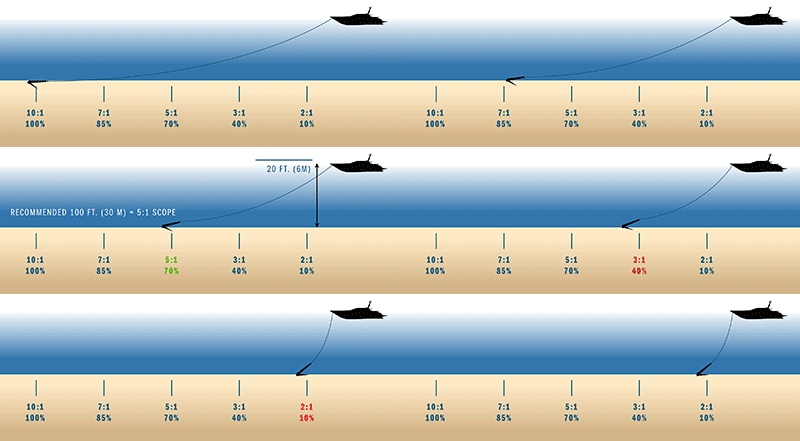
At less than a 3:1 scope, you will give up a significant amount of holding power and may experience problems setting the anchor.
Remember that your depth sounder may be giving you the water depth under your keel, rather than from the true waterline, in which case you need to add your draft plus the height of your deck when calculating scope.
In crowded anchorages where they are many boats nearby, set your anchor initially at a 5:1 scope, then “Power Set” the anchor (see steps below), and afterwards shorten the scope as needed.
4) “Power Set” Your Anchor
To insure that your anchor is properly buried into the sea bottom, it is advisable to “Power Set” it. When initially setting the anchor, you should back down extremely slowly. As the anchor begins to set deeper into the sea bottom, gradually increase the load with your engine to insure that it is secure and well buried.
Keep in mind that if you back down at any speed, you might not give your anchor a chance to dig in and bury itself.
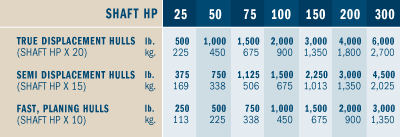
You can simulate the force of the wind by using your engine’s thrust to set your anchor to a predetermined load. Match your boat’s total maximum horsepower and hull type in the table to determine how hard your boat can “Power Set” your anchor.
5) Bahamian Mooring – Using Two Anchors
In areas of changing current or wind, one anchor might not be enough to keep your boat secure. By setting two anchors off the bow in opposite directions, you can help to keep your boat in place and limit swinging, which can cause the anchor to break free. This method is commonly referred to as a “Bahamian Mooring.”
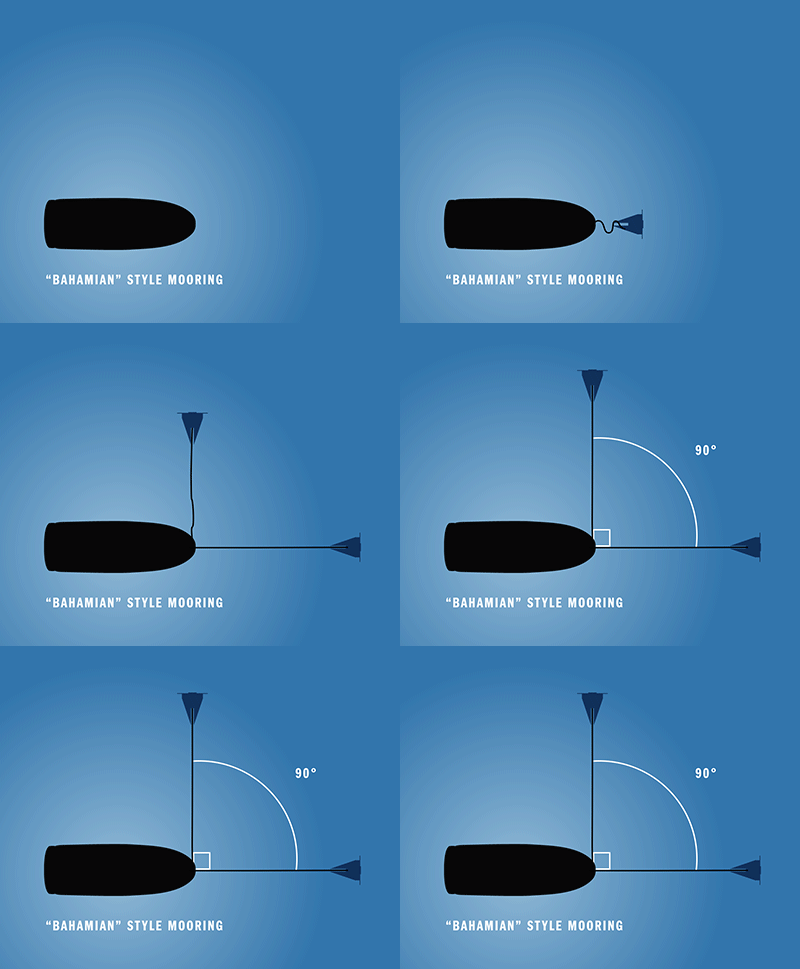
Any anchor can fail to reset once it has been pulled out of the sea bottom. Don’t be fooled by some manufacturer’s claims about an anchor’s ability to dependably reset 100% of the time. Set two anchors if you expect a change in current or wind.
6) Anchoring in Soft Mud Bottoms
All soft mud bottoms offer greatly reduced holding power compared to harder soils, and if setting problems occur, then try setting the anchor initially at very short scope, such as 2:1. As the anchor begins to dig in and set, slowly increase the scope to at least 5:1 and “Power Set” the anchor.
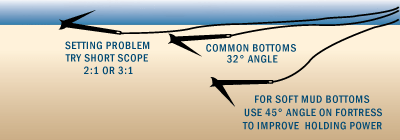
The Fortress flukes can be adjusted from the normal 32 degree angle to 45 degrees to increase holding power in soft mud bottoms by as much as 400%. Also, special “Mud Palms” are included for both Fortress and Guardian anchors to aid setting in very soft problem mud. We recommend that you permanently install the “Mud Palms” on your anchor, as they will help the anchor set faster in any type of bottom.
7) Retrieving Your Anchor
Slowly move the boat to a position directly over the anchor, pulling in the line as you go. Once you are directly above it, snub the line on a cleat and slowly power backwards to pull the anchor out of the bottom. Do not power forward. This will require more energy and put very heavy loads on the anchor and support hardware.